- Home
- Sustainability
- Governance
- Risk Management
Risk Management
Basic Approach
We engage in risk management having established the Risk and Compliance Regulations, covering the various risks related to business operations, and the cross-functional Risk and Compliance Committee.
Additionally, we have also established a system for risk management recognizing that because it has many subsidiaries operating outside of Japan it is extremely important to understand the situation of subsidiaries (identify the emergence of risks) and conveying of policies to subsidiaries.
Operating Risks
The Company’s main operating risks are as follows and can also be found in the securities report.
- 1. Climate change (global warming risks)
- (1) Impacts due to procurement of seafood materials
- (2) Risks from increased frequency and severity of natural disasters
- 2. Risks related to expansion of operations outside of Japan (country risk)
- 3. Risks concerning the Aquaculture Business
- (1) Risks that area-specific fishing rights or water usage rights cannot be maintained or newly acquired in the domestic aquaculture industry
- (2) Risks concerning marine pollution caused by the Aquaculture Business
- (3) Risks concerning the strengthening of environmental regulations applicable to the Aquaculture Business
- (4) Risks concerning the procurement of aquaculture eggs
- (5) MSC and/or ASC certifications
- (6) Mass mortality of fish due to disease
- (7) Introduction of aquaculture licensing in Japan
- 4. Risks involving safety of products
- 5. Risks associated with dependence on specific outsourcing partner[s]
- 6. Risks associated with fish market price volatility
- 7. Raw materials procurement risks (risk of dependence on supplier[s])
- 8. Risks associated with reliance on interest-bearing debt
- 9. Risk involving legal regulations
- 10. Risks involving management of personal information
- 11. Risks involving litigation and/or legal disputes
- 12. Risks involving the ability to secure and develop human resources
- 13. Risks concerning intellectual property rights
- 14. Major shareholders
Risk Management System
Risk and Compliance Committee
The Risk and Compliance Committee (chair: Chief Executive Officer) consists of members including internal directors, outside directors who are Audit & Supervisory Board members, executive officers, department heads, and General Manager of the Internal Audit Department. The committee reports on compliance and risk management comprehensively for the entire company with regard to our operations and reviews countermeasures. Department heads manage risk matters in the daily business activities of their respective department, as well as report on problems identified in daily business activities and their response, and escalate other issues, to the Risk and Compliance Committee.
Additionally, a system is in place to obtain advice from outside experts, as the need arises, such as legal counsel, certified public accountants, tax accountants or labor and social security attorneys, in an effort to prevent risk or discover it at an early stage.
Understanding the Situation of Consolidated Subsidiaries and Conveying of Policies
As the parent company, we dispatch (an) officer(s) to all consolidated subsidiaries and requires that important matters under the Affiliated Companies Management Regulations must be pre-approved by the Company’s Board of Directors.
The group Management Committee, in which thee representatives of consolidated subsidiaries participate, meets every month to discuss financial results, budget, and other general topics.
Our Corporate Planning Department is positioned as the department in charge of affiliated companies management and it has put into place a system for regularly communicating with the frontline operations of each affiliated company.
As a result, we are able to quickly detect risks and better understand the situation of its subsidiaries from both their management level and frontline operations in a timely manner while also working to enhance the effectiveness of its supervisory functions. This information is also reported to the Risk and Compliance Committee as needed.
Response to Climate Change Risks (Risk of Escalation of Disasters)
Since the aquaculture business is a business that uses nature, it faces risks due to natural disasters. These risks cannot be completely avoided. Therefore, we have been promoting the diversification its aquaculture farms for some time, under a policy to mitigate risks to the extent that they can be absorbed through “diversification.”
In addition, we have increased the ratio of land-based farms, which have a low risk of damage. There are two types of land-based farms: A rivertype aquaculture farm that uses rivers and a recycling-type aquaculture farm that uses groundwater. Of these types, the risk of damage is relatively high because the aquaculture farm is severely damaged by overflowing rivers. In particular, in recent years, damage caused by linear precipitation zones has been frequent, and we recognize that the risk is increasing. In August 2022, a flood and landslide occurred in Fukaura, Aomori Prefecture, caused by record-breaking heavy rains. This resulted in extensive damage to our river-type land-based farm in Fukaura Town. On the other hand, recycling-type aquaculture fish farms are at an extremely low risk of damage. In the domestic aquaculture industry, river-type intermediate farms used to have a large share, but in the fiscal year ending June 2024, a closed-loop land-based farm was constructed in Imabetsu Town, Aomori Prefecture to increase the closed-loop land-based farms, which have a lower risk of damage Going forward, we will continue to build a robust production system that is resilient to disasters, taking into account the risk of intensifying disasters.
Number of aquaculture farms
| Japan | Denmark | |
|---|---|---|
| Land-based Farm | 3 | 17 |
| Offshore Aquaculture Farm | 4 | 3 |
As of February 2026
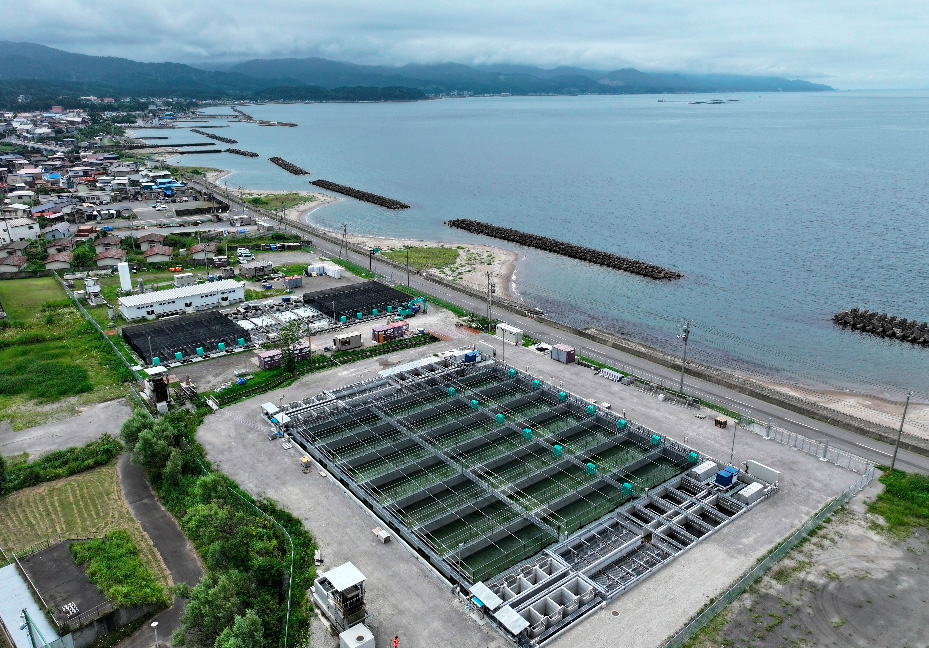
(Imabetsu Town, Aomori Prefecture)
Governance