- Home
- Sustainability
- Environmental
- Response to Climate Change
Response to Climate Change
Reducing CO2 Emissions
Background
We engage in business globally centered on salmon and trout based on a vertically integrated business model spanning upstream to downstream. Fisheries products such as salmon and trout pose the problem of emitting large amounts of CO2 in the transportation process due to the distance between the production and consumption areas.
Our Initiatives
Reduction of CO2 emissions by expanding the domestic aquaculture catch
According to the 2017 Fisheries White Paper, the market for salmon and trout in Japan for raw consumption totals about 100,000 tons, but most of this is imported from overseas. In particular, to import fresh fish without freezing, there is no choice but to rely on air transportation, which emits a large amount of CO2. We will continue to increase the proportion of domestically produced trout in order to improve the domestic self-sufficiency rate for this fish. As a result, we think that this will lead to the reduction of CO2 emissions in transportation.
Additionally, in Southeast Asia where the demand for salmon and trout is strong, most imports come from Scandinavia and South America. We believe that we can contribute to reducing CO2 emissions by increasing the domestic aquaculture production of the Group and increasing supply from Japan, which is closer to Southeast Asia.
Trend in Our Domestic Harvest

Decision to Introduce a New Barge
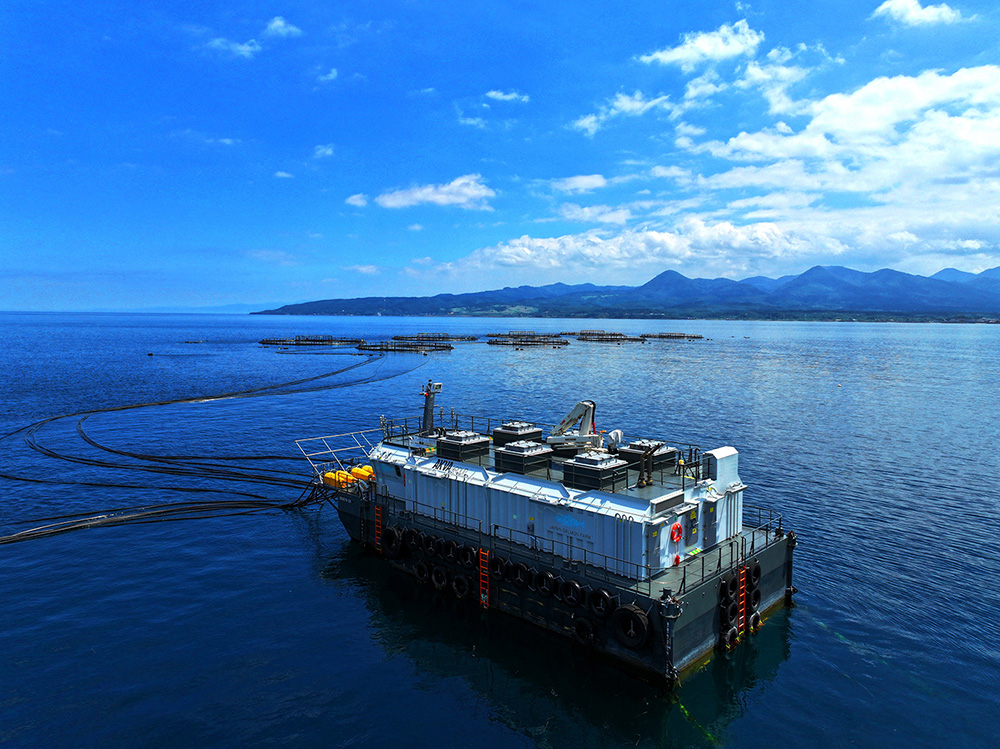
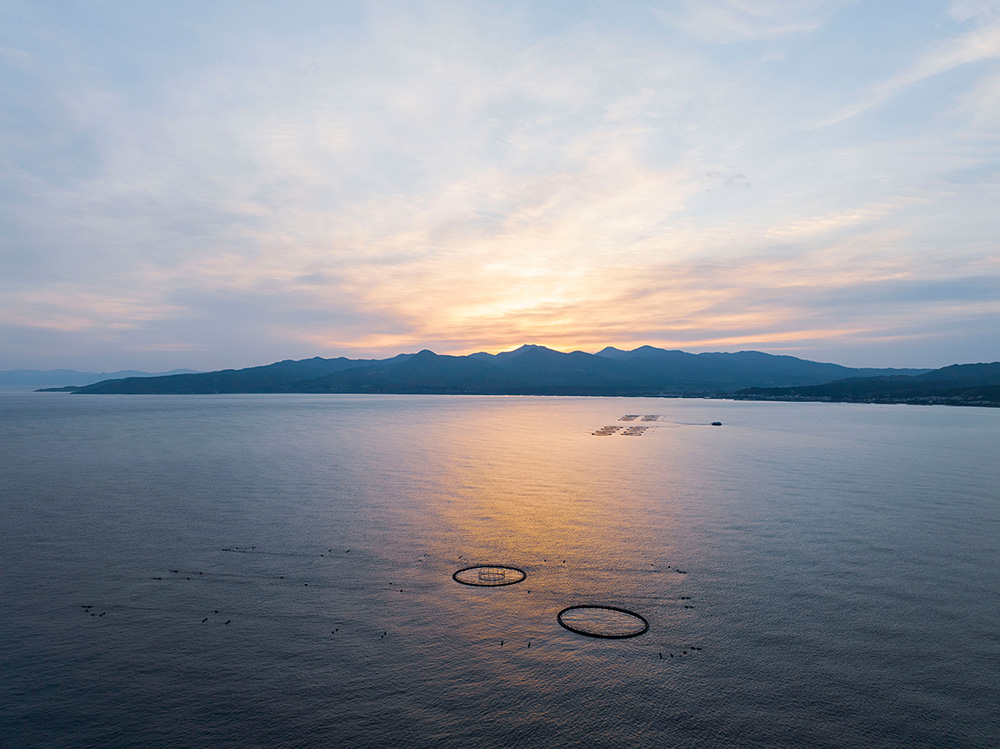
The barge (automatic feeding vessel) introduced to the Imabetsu and Minmaya offshore aquaculture farms in 2023 enabled a significant reduction in diesel consumption compared with the previous method in which small boats shuttled to the cage and kept their engines running.
We concluded that the benefits for operational efficiency and safety were sufficient and decided to build a second new barge.
The new barge is planned to carry 300 metric tons of feed, 25% more than our existing barge. We will ensure the efficiency of large-scale aquaculture—indispensable to achieving our Medium-term Management Strategy 2030—and strive to further increase production while reducing CO2 emissions.
Absorption of CO2 through seaweed aquaculture
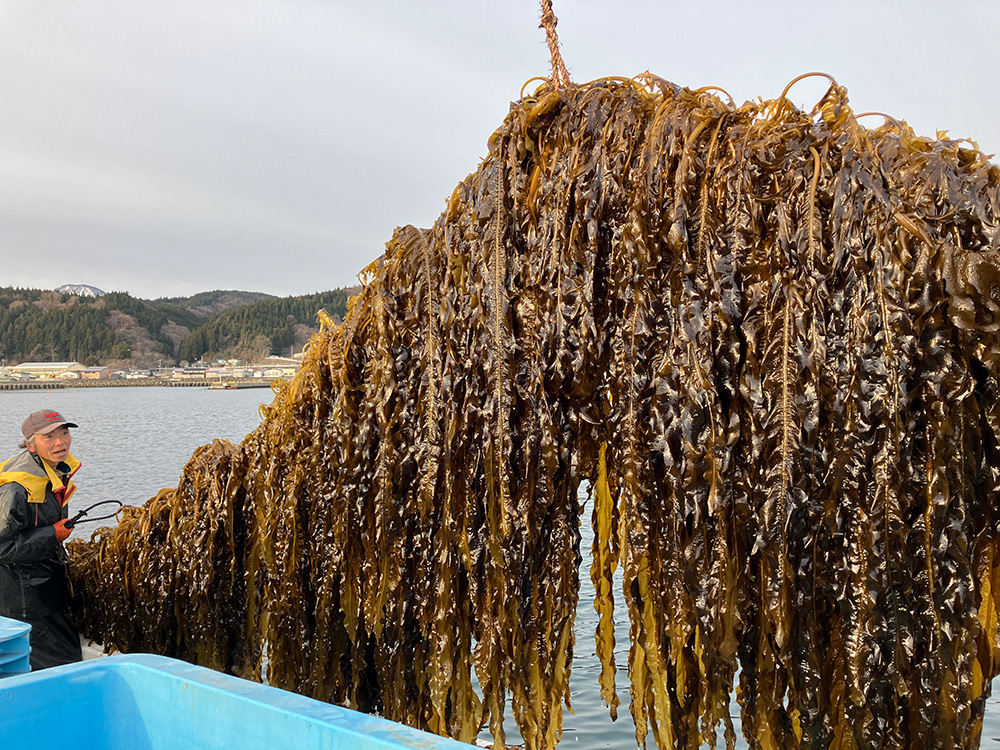
As a measure against blue carbon (carbon in the sea), we have started a trial initiative for farming wakame seaweed. Wakame is a species of kelp native to cold, temperate coasts of the northwest Pacific Ocean. Wakame absorbs CO2 dissolved in the sea, carries out photosynthesis, and releases oxygen. At the same time, carbon accumulates in wakame seaweed and remains on the seabed for a long time after it dies, where it is sequestered. As the amount of wakame increases, more and more CO2 will be absorbed, which is expected to benefit the health of the ocean.
We collected wakame seaweed seedlings in May 2024, started farming the seaweed using offshore aquaculture from November 2024, and harvested it in March 2025. In the current fiscal year, we are continuing experimental aquaculture on the same scale. We hope to make steady progress step by step and develop this into a major venture in the future.
Realizing a maritime modal shift in domestic distribution and sales
Anticipating an increase in domestic aquaculture volumes, we will begin to utilize the semi-ultra-low-temperature (-35°C to -40°C) cold storage warehouse (scheduled for completion in 2027) to be newly constructed in Hachinohe City by our partner logistics company. Until now, cold storage of trout had been spread outside the Aomori prefecture, but we will centralize these operations and promote “"All Aomori" initiative for trout industry”
When we start to utilize this cold storage, we will ship trout via the nearby Hachinohe port and procure feed for trout. By switching from conventional truck transport to maritime transport through this modal shift, we expect to reduce CO2 emissions compared to truck transport.
Acquisition of ASC and MSC Certifications
We have acquired the following certifications related to aquaculture and fisheries.
| ASC certification | MSC certification | |
|---|---|---|
| Okamura Foods Aomori Head Office |
ASC-C-02123 | MSC-C-51492 |
| Okamura Foods Tokyo Head Office |
ASC-C-01295-1 | MSC-C-55616 |
| Japan Salmon Farm Inc. | ASC-C-03543 ASC00219* |
- |
| Musholm A/S Loejstrup Dambrug A/S |
ASC-C-01242 ASC00332* |
MSC-C-55521 |
| Okamura Trading Myanmar | ASC-C-01295-2 | - |
Note: Certification numbers followed by an* are Farm certifications.
The other numbers are CoC certifications.
ASC certification is an international certification regime for aquaculture managed and operated by the Aquaculture Stewardship Council. MSC certification is an international certification regime for fisheries managed and operated by the Marine Stewardship Council.
Chain of custody (CoC) certification is a certification that aims to prevent and appropriately manage the contamination of certified and non-certified marine products in the process of manufacturing, processing, and distribution of ASC and MSC certified products. Farm certification is a certification that certifies that aquaculture is carried out in accordance with the standards established by the ASC.
All of these certification regimes are designed to promote sustainable fisheries and aquaculture that are considerate of fisheries resources, the environment, and society.
Without consideration for the environment and society, the aquaculture and fishing business would no longer be able to provide marine resources sustainably. By expanding the certifications it holds, we aim to provide a stable supply of marine resources into the future.
The Group has acquired the following certifications related to aquaculture and fisheries.
Click here to learn more about ASC certification.