- Home
- Sustainability
- Environmental
- TOPICS Effects of reducing environmental impact through the introduction of barges
TOPICS Effects of reducing environmental impact
through the introduction of barges
Purpose of introducing barges
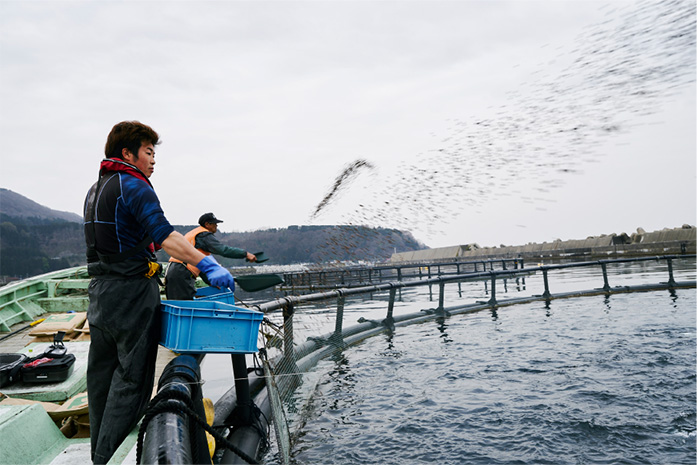
In the past, employees loaded feed onto fishing boats, traveled to the cages offshore, and fed the fish manually at sea.
This method, however, increases the number of man-hours in proportion to the amount of the aquaculture harvest, making it difficult to achieve economies of scale due to large-scale production. There is also the risk that it will be difficult to provide sufficient feed in bad weather conditions and to ensure the safety of employees.
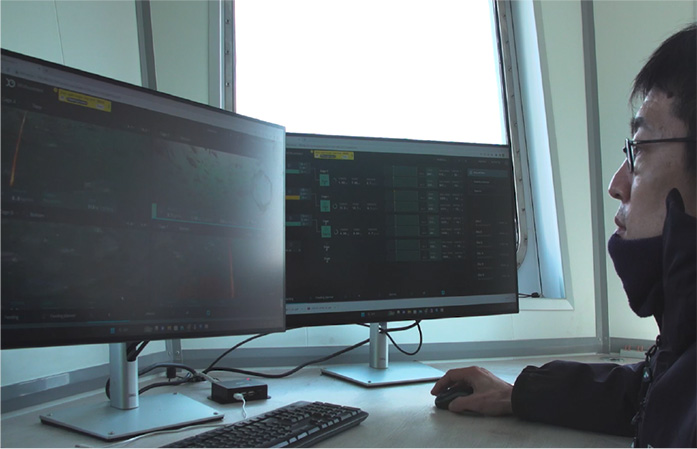
With the aim of solving these issues and modernizing aquaculture through the promotion of smart aquaculture, we introduced this bargebased remote feeding system in domestic trout aquaculture business in 2022.
This systems marks the first of its kind in Japan, and it was made possible by utilizing the operational know-how of our Group company in Denmark.

Effective utilization of resources and reduced environmental impacts
The underwater camera, which observes the appetite of the fish and the water temperature suitable for feeding, makes it possible to feed the fish at exactly the right timing. This has reduced the amount of leftover feed compared to the past, leading to the effective use of resources and the reduction of environmental impacts. As a result, we were able to improve the FCR (feed-conversion ratio) by 3% compared to before.

Systematic growth of fish unaffected by weather conditions
Previously, there were times when fishing boats could not be sent out due to the unstable and dangerous seas, and we had to abandon feeding. Although it is important to systematically feed fish at the right timing to ensure their growth, aquaculture faced the problem that feeding opportunities were affected by the weather.
With the introduction of barges, automatic feeding by remote control has become possible, and a feeding method that is not affected by the weather has been established, leading to planned fish growth.
As a result, we have been able to increase the number of feeding days during the aquaculture period by 24%.
